Alliance Industry Awarded contract for Motor Operated Valve of King Salman International Maritime Industries & Services project
King Salman International Maritime Industries & Services
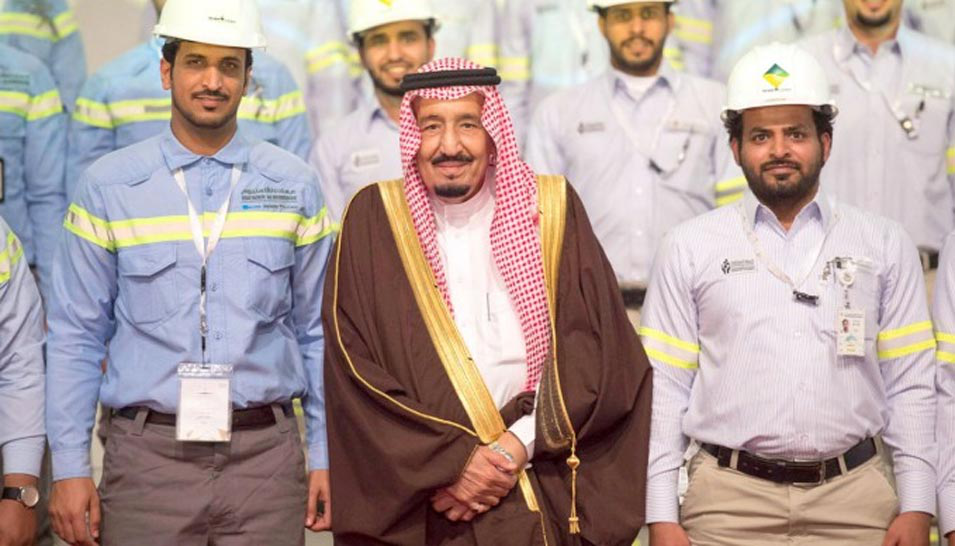
The Custodian of the Two Holy Mosques lays the foundation of the King Salman International Maritime Industries & Services
Saudi Aramco's President and CEO, Amin Nasser
Ras Al-Khair will be a dynamic industrial stronghold in the Kingdom, incubating various industries. Saudi Aramco leads world class marine facilities and services which are considered the largest in the Middle East in terms of volume and production capacity, with at least 30% of its production targeted for export
Complex is the largest of its kind in the region in terms of service capacity, set to make Saudi Arabia a strategic maritime logistics hub.
The Custodian of the Two Holy Mosques King Salman bin Abdulaziz Al Saud laid the cornerstone of the King Salman International Complex for Maritime Industries & Services, near Jubail in the Eastern Province of Saudi Arabia, which was named in his honor during the groundbreaking ceremony. The complex is a commercial maritime project that complements the growth of the Saudi energy industry and helps to meet the development, localization and diversification objectives outlined by Saudi Vision 2030.
The development of the complex will start with a maritime yard as an anchor project to be completed in 2021. It will be managed and maintained by Saudi Aramco’s proposed joint venture with The National Shipping Company of Saudi Arabia (Bahri), Hyundai Heavy Industries Co, and Lamprell PLC. The facility will offer quality, efficiency and economies of scale, and when completed it will offer vessel and rig build, maintenance, repair and overhaul services. The project will comply with all of the Saudi government’s environmental and sustainability requirements.
By 2030, the complex is set to contribute approximately 64 billion Saudi Riyals to the Kingdom’s GDP per year, which will reduce maritime-related imports by 45 billion Saudi Riyals and create more than 80,000 job opportunities by 2030.
His Excellency Khalid Al-Falih, Minister of Energy, Industry and Mineral Resources and Chairman of Saudi Aramco said: “Today marks a groundbreaking example of well-studied efforts towards the diversification of economy with the inauguration of the King Salman International Maritime Complex; such diversification is achieved by investing all available resources in the Kingdom and opening doors for strategic industries to operate and flourish.”
“The Kingdom continues to support and develop the mining sector under competitive conditions, combining innovation and excellence, while pumping huge investments of over 130 billion Saudi Riyals to establish an infrastructure of trains, ports, gas supplies, power, water, sulfur, phosphate and aluminum plants tied to the mining industry established by the Maaden Company,” he added.
“The achievement in Ras Al-Khair is an example of the achievements the Kingdom is capable of making through the convergence of the efforts of all Government agencies, including building and operating integrated basic and industrial infrastructure systems across the country, thus sending out a message to the whole world that once the will is there, we can make achievements that others would consider impossible.”
Saudi Aramco’s President and CEO, Amin Nasser, said: “Ras Al-Khair will be a dynamic industrial stronghold in the Kingdom, incubating various industries. Saudi Aramco leads world class marine facilities and services which are considered the largest in the Middle East in terms of volume and production capacity, with at least 30% of its production targeted for export.”
Nasser added that as part of Saudi Vision 2030, the project will help increase economic diversification and enhance the localization of the energy industry, with Saudi Aramco endeavoring to double the percentage of local content in commodities and services produced in the Kingdom, to reach 70% by 2021.
The complex will host a number of support services facilities and a residential compound with associated recreational amenities. It is expected to commence primary operations in the beginning of 2019. The entire complex is expected to reach full operational capacity by 2021.